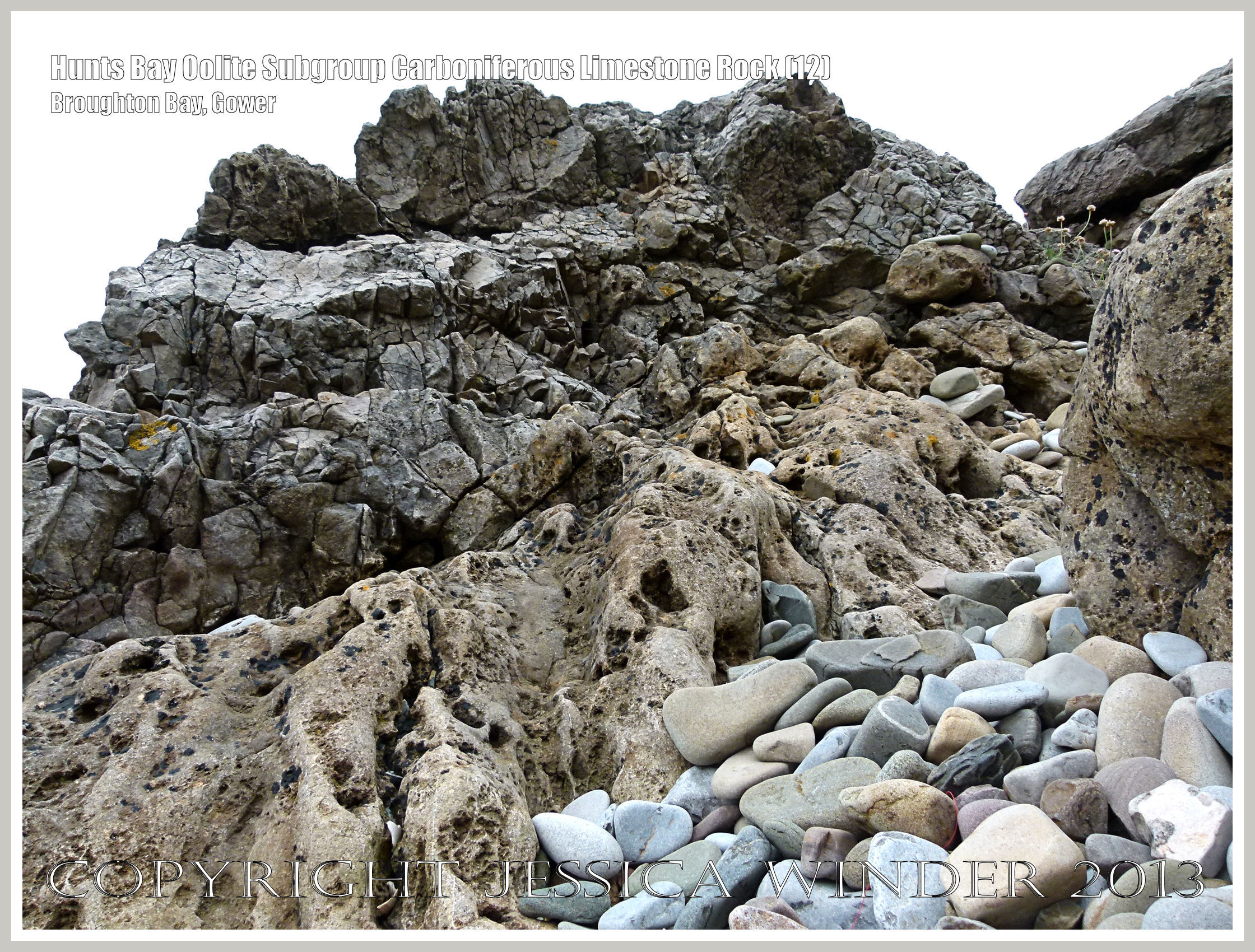
Hunts Bay Oolite Subgroup at Broughton Bay 12 – Rock texture, rock structure, and natural fracture patterns in Hunts Bay Oolite Subgroup formation of the Carboniferous Limestone on the west side of Broughton Bay on the Gower Peninsula in South Wales.
 Jessica's Nature Blog
It seems that the smooth stones in the lower right have a different origin relative to the big rocks. Were they placed by natural or human agents?
Thank you,
Don
LikeLike
The pebbles to which you refer occur there naturally, being polished smooth by rolling around in the waves for centuries. The are likely to have originated from the rock at the base of the nearby outcrop. This looks different from the jumble of fractured rocks above, having a different colour and bearing many fossils, even though it is still apparently part of the same Hunts Bay Oolite Subgroup. In this series of posts about the rocks on the west side of Broughton Bay, I am gradually trying to understand the environmental circumstances prevailing at the time the rocks were formed which would account for the differences in the appearance from the top to the bottom of the cliffs.
LikeLike
Thank you again for taking time to share and explain.
God bless,
Don
LikeLike
Thank you, Don. This is something I am working on. I will get a better understanding of this piece of geology in the fullness of time. That’s the joy of learning.
LikeLike